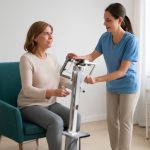
Caring for a loved one at home often means navigating the delicate balance between providing support and preserving dignity. For individuals who have lost some leg strength but can still bear weight, the daily tasks of moving from a chair to a bed, or from a wheelchair to a toilet, become fraught with risk. Falls are a leading cause of injury among older adults, and caregivers frequently suffer back strain from improper lifting. A sit to stand lift for home use is specifically engineered to address this challenge—it is not a full-body sling lift but a device designed to assist users who can stand with partial support. By guiding the patient through a natural standing motion, these lifts reduce fall risk and dramatically lower the physical toll on caregivers. This article explores how these devices work, why they are a game-changer for home care, and what real-world factors make them indispensable.
How a Sit to Stand Lift Works and Why It Matters for Home Care
A sit to stand lift operates on a simple yet effective biomechanical principle. The user sits on a padded, contoured seat or sling while their feet rest on a stable footplate. A knee pad is positioned to prevent the user from sliding forward during the lift. The lift itself—often powered by a rechargeable battery or a manual hydraulic pump—raises the user from a seated to a standing position. Unlike a ceiling lift or a full-body sling lift, this device requires the user to actively participate by bearing some weight and using their own leg muscles. This is critical for maintaining muscle tone and circulation, which can decline rapidly with complete immobility.
In a home environment, space and ease of use are paramount. Most models are compact, with a narrow base that can fit through standard doorways and maneuver around furniture. The sit to stand lift for home use eliminates the need for two or more caregivers to perform a manual transfer. Without it, a caregiver might attempt a pivot transfer, which demands balance and coordination from both parties. One misstep can lead to a fall, resulting in a hip fracture or head injury. According to data from the Centers for Disease Control and Prevention, falls account for over 95% of hip fractures in older adults, and many of these incidents occur during transfers. By providing a stable, controlled lifting motion, these devices drastically cut that risk.
Another practical advantage is the reduction in caregiver strain. Manual lifting of a partially weight-bearing person forces the caregiver to twist, bend, and exert force in ways that are biomechanically unsafe. Over time, this leads to chronic back pain and job-related injury. A sit to stand lift for home use transfers the load to the machine, allowing the caregiver to guide the patient with minimal effort. The lift’s hand control lets the caregiver adjust the height and speed, ensuring a smooth, comfortable rise. Many modern units also feature a walking harness attachment, enabling the user to take assisted steps while the lift supports most of their weight—ideal for rehabilitation after surgery or stroke.
Key Considerations When Choosing a Home Use Sit to Stand Lift
Selecting the right lift for a home requires careful evaluation of the user’s physical condition, the home layout, and the daily care routine. First, assess the user’s weight-bearing capacity. These lifts are designed for individuals who can bear at least 30–50% of their own weight. If the user has significant lower body weakness or paralysis, a full-body sling lift would be more appropriate. Weight capacity is also crucial—most home models support 300–450 pounds, but heavy-duty versions extend beyond that. The sling or seat must fit the user comfortably. A sling that is too small can cause pressure points, while one that is too large may not provide adequate support during the lift.
Another critical factor is the base type. Fixed-base lifts are stable but require the user to position themselves directly over the base. They are ideal for bed-to-chair transfers in a single location. Spreading-base (or “open-base”) lifts allow the caregiver to push the lift over a chair or toilet without moving the user first. These are more flexible for home bathrooms or living rooms where furniture cannot be easily rearranged. The base should also have locking casters to prevent rolling during the lift. Battery life matters—look for a lift that can perform at least 20 full cycles on a single charge. A battery indicator and emergency manual lowering feature are non-negotiable safety elements.

User comfort and dignity often get overlooked in technical discussions. A padded seat versus a fabric sling can change the user’s experience dramatically. Many users prefer a split-leg sling for toilet transfers because it allows access without fully undressing. The knee pad should be padded and adjustable to accommodate different leg lengths. Noise level is another practical concern: a loud motor in a quiet home can be startling. Modern lifts use whisper-quiet actuators. Finally, consider the learning curve. Caregivers should receive hands-on training from the supplier or occupational therapist. A device that is simple to raise and lower, with intuitive controls, reduces the daily stress of caregiving. Reading reviews from other home users can reveal real-world quirks, such as difficulty maneuvering on thick carpet or tight corners.
Real-World Applications: Case Studies and Sub-Topics in Home Use
To illustrate the transformative impact of these lifts, consider the case of a 78-year-old man recovering from a total hip replacement. He could bear weight on his surgical leg but had significant pain and instability during standing. His wife, his primary caregiver, had a history of back injuries. Before acquiring a sit to stand lift, she performed pivot transfers with a gait belt, which left both of them exhausted and anxious. After installing the lift beside their bed and bathroom chair, his wife simply wheeled the lift into position, engaged the knee pad, and pressed the up button. The patient reported feeling in control because he could push through his legs rather than being “hoisted.” Within two weeks, his pain decreased, and he began walking short distances with a walker. The lift became a stepping stone to regained mobility, not a crutch for dependence.
Another example involves a middle-aged woman with multiple sclerosis who used a power wheelchair for long distances but could stand for brief periods. She wanted to use a standard toilet rather than a bedside commode to maintain normalcy. Her bathroom had a narrow doorway and limited floor space. A spread-base sit to stand lift allowed the caregiver to position the lift over the toilet without shifting the woman onto a separate commode. The split-leg sling meant she could remain fully dressed until the lift was engaged. The lift’s small turning radius let it navigate the bathroom corner. This setup not only preserved her privacy but also enabled her to participate in family meals without the logistical nightmare of a commode near the dining table.
Sub-topics worth exploring include the role of these lifts in post-acute rehabilitation. Hospitals often use sit to stand lifts for early mobilization of surgery patients. For home use, the same principle applies: early standing after knee or hip surgery reduces the risk of blood clots and pneumonia. Physical therapists recommend using the lift for sit-to-stand exercises as part of a strengthening routine. The lift can be set to provide minimal assistance initially, then progressively lowered as the patient regains strength. A case study from a home health agency showed that a 65-year-old woman with COPD regained her ability to stand from a low chair after three months of daily practice with a sit to stand lift, ultimately eliminating her need for the device.
Caregiver fatigue is another sub-topic that deserves attention. In a survey conducted by the National Alliance for Caregiving, 40% of caregivers reported high physical strain. After introducing a sit to stand lift, 85% of those surveyed said their strain decreased, and 70% reported a reduction in fear of falling for the care recipient. The device also frees up time: a manual lift with two caregivers might take five minutes and require intense concentration, whereas a powered lift can complete a transfer in under a minute with one caregiver. This efficiency reduces the mental load and can improve the caregiver’s ability to provide emotional support.
Finally, consider the psychosocial impact. Many elderly individuals resist using mobility aids because they associate them with frailty or dependence. However, a sit to stand lift can actually promote feelings of autonomy. When a person knows they can stand safely with minimal assistance, they are more likely to attempt standing throughout the day—to look out a window, reach a glass, or greet a visitor at the door. This incidental activity improves circulation, maintains joint flexibility, and combats the depression that often accompanies prolonged sitting. The lift becomes an enabler of life, not a symbol of limitation. Its presence in the home signals a commitment to safety, dignity, and proactive health management—values that resonate deeply with families navigating the challenges of aging or disability.